Blog
We keep you up to date on the latest tax changes and news in the industry.
Navigating QuickBooks: Avoiding Common Pitfalls Before Taxes

QuickBooks has emerged as a cornerstone for accounting in small businesses, praised for its robustness, adaptability, and ability to streamline bookkeeping tasks when used effectively. However, as many business owners realize, without proper setup and ongoing management, QuickBooks can become a maze rather than a solution.
As tax season draws near, numerous businesses find themselves grappling with QuickBooks files muddled with duplications, mismatches, and mismanaged data, turning a tool meant for financial clarity into a source of confusion.
Understanding why QuickBooks challenges arise and rectifying them early can transform your financial management strategy. Here’s how you can ensure your QuickBooks works seamlessly, especially before tax crunch time.
1. The Importance of a Correct QuickBooks Setup
While QuickBooks is marketed as effortlessly intuitive, the platform demands a meticulously established chart of accounts, class tracking, and bank rule settings—tasks best left to those with accounting expertise.

A professionally crafted setup prevents inconsistencies such as:
Incongruent account categories versus tax designations
Misalignment in bank transactions
Redundancies in vendor and customer entries
Inaccurately posted opening balances
Income recorded in erroneous periods
The initial investment in a professional setup can save substantial costs and time down the line.
2. Misconceptions About Bank Feed Automation
Bank feeds are a celebrated QuickBooks feature, bringing convenience but also pitfalls. Transactions appearing automatically might give the impression of accuracy, yet they often necessitate careful oversight.
Automation doesn’t assure:
Proper categorization
Accurate linking of deposits with invoices
Comprehensive tracking of loans' principal and interest
Correct classification of owner draws and contributions
Precise cost of goods sold calculations
A trained eye is essential to ensure the books align correctly and errors are rectified timely.

3. Financial Insight, Not Solution
Utilizing QuickBooks provides a transparent view into your financial status but doesn’t automatically resolve underlying issues such as cash flow management. Timely collection of receivables and controlled expenditures are crucial endeavors outside QuickBooks’ automation capabilities.
Collaborating with professionals can aid in using QuickBooks to:
Craft realistic cash flow projections
Spot spending inefficiencies
Formulate comprehensive budgets
Monitor profit margins closely
Understand business seasonality and its financial implications
Ultimately, QuickBooks serves best as a tool complemented by strategic advisory and oversight.
4. The Complexities of QuickBooks Payroll

Handling payroll within QuickBooks may seem straightforward, yet errors here can lead to significant financial repercussions. Mistakes in employee classifications, overtime calculations, or tax withholdings can trigger unpleasant compliance issues.
Outsourcing payroll management to professionals or conducting periodic reviews can safeguard your business from costly mistakes and regulatory penalties.
5. Proactive Year-End Preparation
The rush to rectify a year’s worth of bookkeeping errors during January to March is a common scenario. Issues such as uncategorized expenses, duplicated entries, mismatched inventory, and inappropriate loans as income can be daunting.
Timely and consistent maintenance of QuickBooks files can prevent frantic year-end cleanups, reduce stress, and align financial data accurately for tax purposes.
Next Steps for Robust Financial Health
If your QuickBooks records seem overwhelming, take proactive steps:
Engage in a detailed QuickBooks review with our experts to preemptively address errors.
Ensure your data is tax-preparation ready.
Implement robust workflows for invoicing and payroll.
Regularly consult with us to maintain financial order and accuracy.
Conclusion: QuickBooks is a formidable tool for financial management when implemented and maintained correctly. Partnering with our team ensures your focus can shift from managing errors to growing your business sustainably. Get in touch with us today.
Sign up for our newsletter.
Each month, we will send you a roundup of our latest blog content covering the tax and accounting tips & insights you need to know.
We care about the protection of your data.
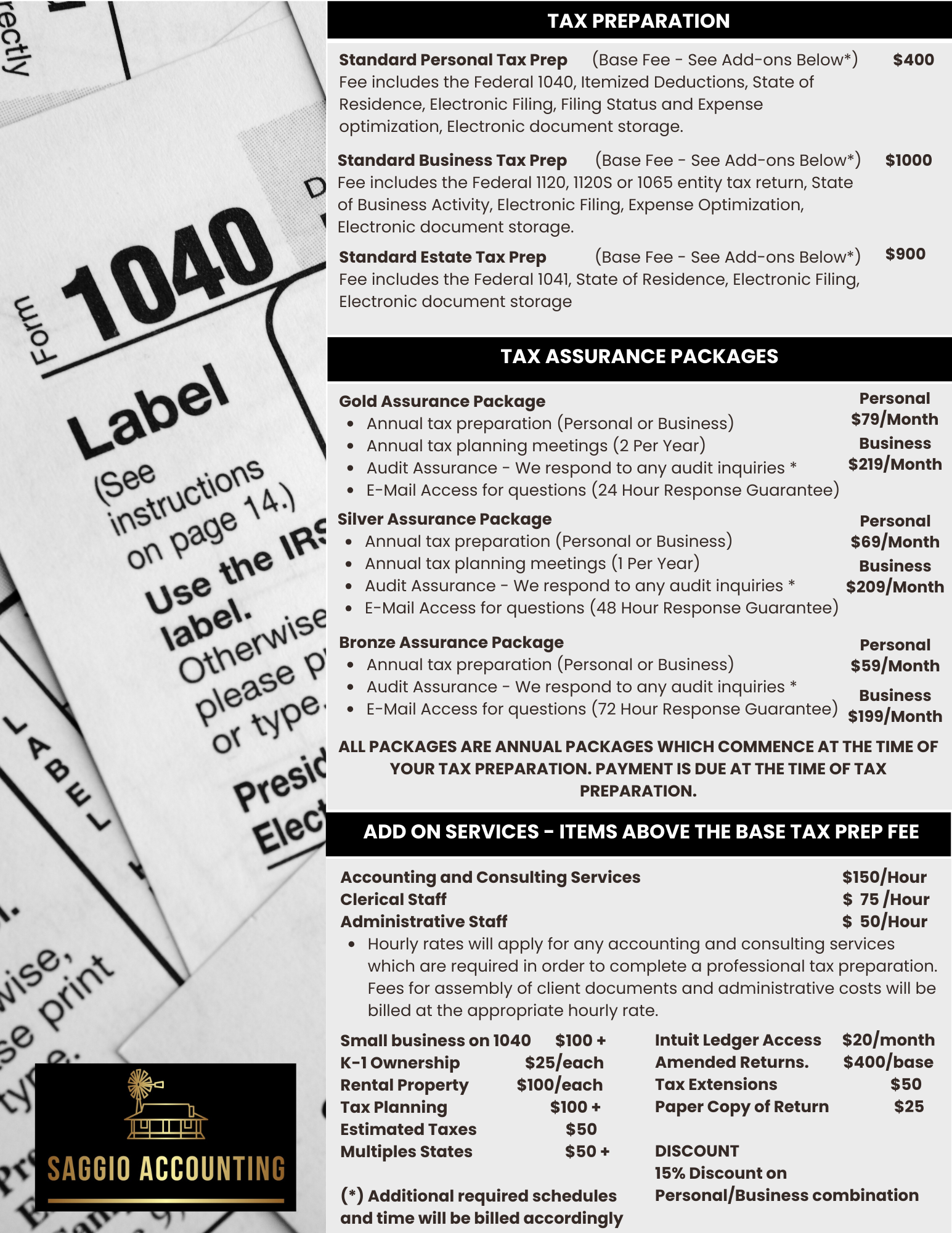
TAX ASSURANCE PRICING
Personal Income Tax Services
In addition to our normal tax preparation service, we also offer the Tax Assurance Packages for those clients who want more than just a tax preparation. These packages are annual packages which provide superior tax preparation, tax planning and access to a tax expert via e-mail. All of these additional services are free of charge to those clients who select on of our Tax Assurance Packages.
Bronze Assurance Package
-
Annual Tax Preparation
-
Audit Assistance - We respond to audit inquiries
-
E-Mail Access for questions (72 Hour Response)
Gold Assurance Package
-
Annual Tax Preparation
-
2 Tax Planning Meetings per year
-
Audit Assistance - We respond to audit inquiries
-
E-Mail Access for questions (24 Hour Response)
Silver Assurance Package
-
Annual Tax Preparation
-
Annual Tax Planning Meeting
-
Audit Assistance - We respond to audit inquiries and E-Mail Access for questions (36 Hour Response)
TAX ASSURANCE PRICING
Business Income Tax Services
In addition to our normal tax preparation service, we also offer the Tax Assurance Packages for those clients who want more than just a tax preparation. These packages are annual packages which provide superior tax preparation, tax planning and access to a tax expert via e-mail. All of these additional services are free of charge to those clients who select on of our Tax Assurance Packages. These packages include both the business and personal tax related preparation services.
Bronze Assurance Package
-
Annual Tax Preparation (Business and Personal)
-
Audit Assistance - We respond to audit inquiries
-
E-Mail Access for questions (72 Hour Response)
Gold Assurance Package
-
Annual Tax Preparation (Business and Personal)
-
2 Tax Planning Meetings per year
-
Audit Assistance - We respond to audit inquiries
-
E-Mail Access for questions (24 Hour Response)
Silver Assurance Package
-
Annual Tax Preparation (Business and Personal)
-
Annual Tax Planning Meeting
-
Audit Assistance - We respond to audit inquiries and E-Mail access for questions (48 Hour Response)